Commercial trucks are designed to carry heavy loads—but only within strict weight limits. When trucking companies overload their vehicles or fail to distribute cargo properly, the consequences on Tennessee’s highways can be catastrophic.
Whether on I-40, I-65, I-75, I-24, or on Tennessee’s rural freight corridors, overloaded trucks are significantly more likely to cause severe collisions such as rollovers, jackknife accidents, brake failures, and multi-vehicle crashes.
At Tennessee Accident Law, we’ve represented victims across the state whose lives were shattered because a trucking company chose profit over safety. Weight violations are not innocent mistakes—they are dangerous, illegal acts that put everyone at risk.
This article explains why overloaded trucks are so hazardous, how weight violations happen, and how truck accident victims can prove negligence under Tennessee and federal law.
If you have immediate questions, call us at (615) 212-9866 or complete our free case evaluation form now.
The Legal Weight Limits for Commercial Trucks
Federal and state law strictly regulate how much commercial trucks are allowed to weigh.
1. Federal Weight Limits (FMCSA & FHWA)
Under federal law, the maximum allowable weights are:
- 80,000 pounds gross vehicle weight
- 20,000 pounds on a single axle
- 34,000 pounds on a tandem axle
Trucks exceeding these thresholds require special permits—not the norm in most commercial freight operations.
2. Tennessee Weight Limits (TN DOT)
Tennessee generally mirrors federal laws and enforces weight restrictions through:
- Weigh stations
- Portable roadside scales
- Tennessee Highway Patrol commercial vehicle units
When a truck is overloaded, it violates not only state and federal regulations—but also basic principles of physics that make safe operation impossible.
Why Overloaded Trucks Are So Dangerous
An overloaded truck behaves differently from a properly loaded one. Excess weight compromises nearly every safety system on the vehicle.
1. Brake Failure and Overheating
The braking system is the FIRST component to fail in an overloaded truck.
Excessive Weight Causes:
- Brake overheating
- Increased stopping distance
- Brake pad failure
- Complete loss of braking power
- Rollover during emergency braking
On steep Tennessee grades—especially near Chattanooga, Knoxville, and the Cumberland Plateau—this becomes deadly.
2. Tire Blowouts
Too much weight leads to:
- Excessive heat
- Tire delamination
- Explosive blowouts at high speed
A blowout on an 18-wheeler can send debris flying and cause immediate loss of control.
3. Reduced Steering and Stability
Overloaded trucks become extremely difficult to maneuver.
Risks Include:
- Trailer sway
- Loss of directional control
- Wide turns causing collisions
- Increased rollover risk during lane changes
On Tennessee’s busy interstates, a stability failure often leads to multi-vehicle crashes.
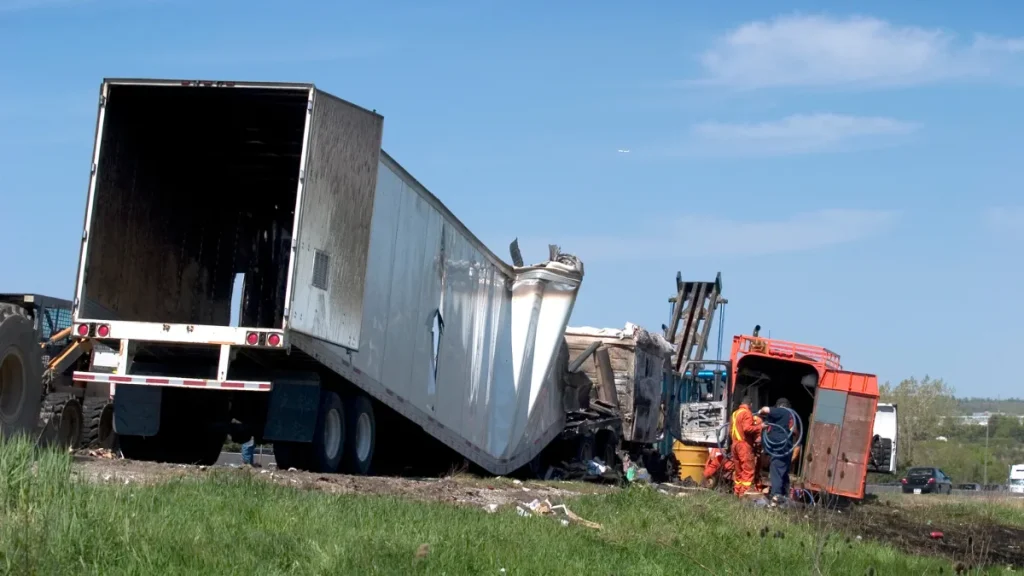
4. Jackknife Accidents
Overweight cargo creates uneven braking between the tractor and trailer.
This leads to:
- The trailer swinging outward
- The truck folding into a “V” shape
- Total loss of control
Jackknife accidents are among the most destructive crashes we see in Tennessee.
5. Increased Stopping Distances
A fully-loaded legal truck already takes 300+ feet to stop at highway speeds.
Overloaded trucks take significantly longer—sometimes two or three football fields.
On Tennessee interstates with heavy traffic, delayed braking directly causes rear-end and multi-car collisions.
6. Rollovers
Improperly distributed weight raises the truck’s center of gravity.
Common Rollover Situations:
- Curves and ramps (especially on I-24/I-40 interchanges)
- Emergency swerves
- Improper lane changes
- Exiting off-ramps too quickly
- Uneven road surfaces
Rollover accidents often cause mass casualties and highway shutdowns.
Why Weight Violations Happen
Most overloaded truck cases we handle are not accidents—they’re deliberate acts of negligence.
1. Maximizing Profit
More cargo = more money.
Some carriers overload trucks to avoid paying for:
- Extra loads
- Additional drivers
- Extra trucks in the fleet
2. Pressure from Shippers
Shippers sometimes load trucks beyond limits and expect drivers to:
- Sign off on weight
- Transport illegal loads
- Skip weigh stations
3. Avoiding Costs
Companies may ignore maintenance or safety issues when overloaded:
- Old brake systems
- Worn tires
- Faulty suspensions
4. Fraudulent Load Documents
Logs may be falsified to hide overweight cargo.
5. Inexperienced or Poorly Trained Drivers
Some drivers do not know how to identify weight violations—or are pressured not to report them.
Liability in Tennessee Overloaded Truck Accident Cases
Multiple parties may be responsible for an overloaded truck crash.
Potential Defendants Include:
- The truck driver
- The trucking company
- The loading company
- The freight shipper
- A third-party logistics company
- The trailer manufacturer (if rating is exceeded)
We aggressively identify and pursue ALL liable parties.
How Tennessee Accident Law Proves an Overloaded Truck Caused the Crash
Overloaded truck accidents require detailed investigation. Our firm uses advanced techniques to uncover the truth.
1. Black Box (ECM) Data
Shows:
- Speed
- Braking patterns
- Engine strain
- Weight-related performance issues
2. Weigh Station Logs & Bypass Records
We investigate:
- Missed weigh stations
- Bypass violations
- Flagged overweight readings
3. Bills of Lading and Cargo Documents
These often contain:
- False weight entries
- Alterations
- Missing signatures
4. Physical Evidence
A crushed axle or blown tire can indicate illegal weight.
5. Expert Analysis
We work with:
- Accident reconstructionists
- Cargo securement experts
- Mechanical engineers
Their testimony helps jurors understand how weight caused the crash.
Common Arguments Trucking Companies Use — and Why They Fail
Trucking companies often claim:
- “The weather caused it.”
- “The other driver was at fault.”
- “The driver didn’t know the cargo weight.”
- “The scale was inaccurate.”
We dismantle these defenses using documentation, electronic records, and expert testimony.
Available Compensation for Victims of Overloaded Truck Accidents
Victims may recover damages for:
Economic Damages
- Medical bills
- Future medical treatment
- Lost wages
- Loss of earning capacity
- Property damage
Non-Economic Damages
- Pain and suffering
- Emotional distress
- Loss of enjoyment of life
- Permanent disability
Punitive Damages
When a company knowingly overloads a truck, punitive damages may apply under Tennessee law.
Why Victims Need an Experienced Tennessee Truck Accident Attorney
Weight violation cases are complex, involving:
- FMCSA rules
- Tennessee DOT regulations
- Physics and engineering evidence
- Multi-party liability
- Fraudulent documentation
At Tennessee Accident Law, we know how to expose illegal practices and hold negligent companies accountable.

Take Action Today
If you or a loved one was injured in a truck accident caused by an overloaded or overweight vehicle, you deserve justice — and maximum compensation.
Contact Tennessee Accident Law for a free case evaluation or call 615-212-9866.
We will uncover weight violations, prove negligence, and fight relentlessly for your future.
Sources
Tennessee Department of Transportation (TDOT) – Commercial vehicle regulation and enforcement
https://www.tn.gov/tdot
Federal Motor Carrier Safety Administration (FMCSA) – Cargo and weight regulations
https://www.fmcsa.dot.gov
Federal Highway Administration (FHWA) – National truck size and weight standards
https://www.fhwa.dot.gov