Every commercial truck on Tennessee highways — from I-65 in Franklin to I-40 in Knoxville — operates under strict federal safety laws. These rules, enforced by the Federal Motor Carrier Safety Administration (FMCSA), exist to protect drivers, passengers, and everyone sharing the road.
But when trucking companies violate these regulations, accidents happen — and those violations often become the key to winning your case.
At Tennessee Accident Law, we use federal trucking laws as powerful tools to prove negligence, hold corporations accountable, and secure justice for victims. Here’s how these complex regulations directly affect Tennessee truck accident claims and why they can determine the outcome of your lawsuit.
Call us now at 615-212-9866 to speak with an experienced attorney about your truck accident case.
The FMCSA: Setting the National Standard for Trucking Safety
The Federal Motor Carrier Safety Administration (FMCSA) oversees all commercial trucking operations in the United States. Its regulations govern everything from how long drivers can work to how often vehicles must be inspected.
Tennessee trucking companies are required by law to comply with these federal standards — no exceptions.
When they don’t, those violations can serve as concrete evidence of negligence in your personal injury case.
Key Federal Regulations That Impact Tennessee Accident Claims
1. Hours-of-Service (HOS) Rules
Fatigued driving is one of the most common causes of catastrophic truck crashes. FMCSA Hours-of-Service (HOS) regulations limit how long drivers can stay behind the wheel.
- 11-hour rule: Drivers may drive a maximum of 11 hours after 10 consecutive hours off duty.
- 14-hour rule: Drivers cannot drive beyond the 14th consecutive hour after starting their shift.
- 30-minute rest rule: A break is required after 8 hours of driving time.
When a trucker violates these limits — often under company pressure — the driver and employer can both be held liable for the resulting crash.
Our attorneys routinely subpoena electronic logging device (ELD) data to expose these violations.
2. Driver Qualification Standards
The FMCSA requires all truck drivers to meet specific qualifications before operating a commercial vehicle. These include:
- A valid Commercial Driver’s License (CDL)
- Passing a medical exam confirming physical fitness
- A clean driving and criminal record
- Proper training and safety certifications
When companies hire or retain drivers who don’t meet these standards, it’s a direct form of negligent hiring — and a major factor in Tennessee truck accident lawsuits.
3. Vehicle Inspection and Maintenance Requirements
Every commercial truck must be regularly inspected and properly maintained. Under 49 CFR § 396, carriers must:
- Keep detailed maintenance and inspection records
- Repair defective or unsafe parts before operation
- Conduct pre-trip and post-trip inspections
When companies falsify maintenance logs or neglect repairs, they violate both federal law and Tennessee Code § 55-10-205, which mandates safe vehicle operation.
A single faulty brake inspection can mean the difference between a safe trip and a deadly collision.
4. Cargo Securement and Weight Limits
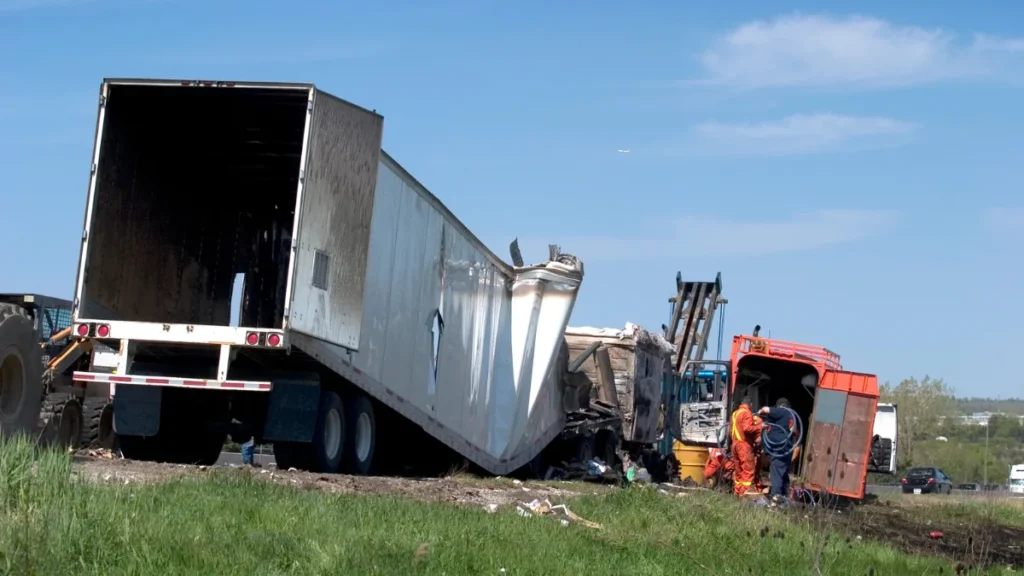
Improperly loaded or overweight trucks are a leading cause of rollovers and jackknife accidents. FMCSA cargo securement rules require that freight be:
- Properly distributed across axles
- Tied down with approved restraints
- Inspected during transit
Violating these standards can make the cargo loader, shipper, or trucking company liable. In Tennessee, this often applies to distribution centers and freight hubs near Franklin, Nashville, and Memphis.
5. Drug and Alcohol Testing Regulations
FMCSA regulations (49 CFR § 382) require mandatory drug and alcohol testing:
- Before employment
- After an accident
- Randomly throughout the year
When employers fail to perform or enforce testing, they can be sued for negligence.
A single violation of these rules can result in both federal penalties and civil liability if an impaired driver causes a crash.
6. Recordkeeping and Reporting Requirements
Trucking companies must maintain detailed records for each driver, including:
- Driving history and employment verification
- Hours-of-Service logs
- Maintenance and inspection documents
- Safety incident reports
Failure to preserve these records — or intentional destruction — is not only a violation of federal law but also spoliation of evidence, which can strengthen your Tennessee personal injury claim.
At Tennessee Accident Law, we move fast to obtain this evidence before it disappears.
How Federal Violations Prove Negligence in Tennessee
In truck accident litigation, one of the most effective strategies is demonstrating that a defendant violated federal safety standards.
Under Tennessee law, a violation of a statutory or regulatory duty is strong evidence of negligence.
This concept is known as “negligence per se.”
In other words, if a trucking company breaks a federal safety rule — such as exceeding driving hours or falsifying maintenance logs — they’re presumed negligent unless they can prove otherwise.
Our attorneys use these violations to build airtight cases and maximize client compensation.
Common Federal Violations We Uncover
Over two decades of case investigations, Tennessee Accident Law has exposed recurring violations, including:
- Drivers exceeding legal hours behind the wheel
- Tampered or missing black box data
- Faulty brakes or tires ignored for months
- Unqualified or medically unfit drivers
- Forged inspection and maintenance records
- Dispatchers pressuring drivers to break safety rules
Each of these violations strengthens your claim — especially when tied directly to the crash that caused your injuries.
The Intersection of Federal and Tennessee Law
Truck accident cases in Tennessee are governed by both state negligence statutes and federal safety laws.
The relationship between them is crucial:
- Federal regulations set the minimum safety standards.
- Tennessee law determines how those violations translate into financial liability.
For example:
- A trucker violating FMCSA HOS rules may face fines federally — but under Tennessee negligence law, that same violation supports a civil lawsuit for damages.
That’s why you need attorneys who understand both systems and how to make federal rules work in your favor.
How Tennessee Accident Law Uses Federal Regulations to Win Cases
Our firm integrates federal compliance data into every stage of litigation. We:
- Retrieve ELD and black box data to document HOS violations.
- Analyze inspection and maintenance records for falsifications.
- Depose company safety officers to uncover systemic negligence.
- Use expert testimony to translate federal violations into civil liability.
- Leverage FMCSA databases to track a company’s prior safety history.
By showing juries and insurers that a company repeatedly broke federal rules, we turn technical regulations into compelling, human stories of corporate irresponsibility.
Potential Damages in Federal Violation Cases
When a Tennessee truck accident involves federal safety breaches, victims may be entitled to enhanced damages, including:
- Medical expenses (emergency, surgical, and rehabilitative)
- Lost wages and reduced earning capacity
- Pain and suffering
- Emotional distress
- Punitive damages, if the violation was reckless or intentional
Courts often view willful disregard of FMCSA regulations as evidence of gross negligence, justifying larger awards.

Why Tennessee Accident Law
As a plaintiff-only law firm, we represent injured Tennesseans — never corporations or insurers. Our team has:
- 20+ years of experience in truck accident and regulatory litigation
- Deep understanding of FMCSA enforcement and Tennessee law
- Proven results against major trucking and logistics companies
- A mission to restore justice for victims across the state
We don’t settle for easy answers — we uncover the truth and make it count in court.
Get Legal Help Now
If you’ve been injured in a Tennessee truck accident, don’t face powerful trucking companies alone. Their defense teams know the rules — and how to bend them. We know how to prove they broke them.
Contact Tennessee Accident Law today for a free case evaluation or call 615-212-9866.
We’ll uncover every violation, expose every act of negligence, and fight for the full justice you deserve.
Sources
- Federal Motor Carrier Safety Administration (FMCSA) — Commercial vehicle safety and compliance regulations.
- Tennessee Code Annotated § 55-10-205 — Safe operation and maintenance requirements under state law.
- U.S. Department of Transportation (DOT) — Federal transportation safety standards and oversight.