Truck drivers rely on one critical assumption every time they pull out onto a Tennessee roadway: the load behind them is properly loaded and secured. When that assumption is wrong, the consequences can be catastrophic. Improperly loaded trailers can cause sudden shifts in weight, loss of control, jackknifes, rollovers, and violent crashes—often injuring the truck driver who had no role in loading the freight.
At Tennessee Accident Law, we represent truck drivers injured in crashes caused by negligent loading by third parties. These cases are complex, evidence-driven, and often involve corporate defendants who aggressively deny responsibility. This article explains how improper loading causes truck accidents, who can be held accountable, and how injured truck drivers in Tennessee can prove negligent loading and recover full compensation.
If you have immediate questions, call us at (615) 212-9866 or complete our free case evaluation form now.
What Does “Improperly Loaded” Mean?
A trailer is improperly loaded when cargo is:
- Unevenly distributed
- Overloaded
- Improperly secured
- Poorly braced or blocked
- Loaded without regard to weight limits or center of gravity
- Loaded using defective or inadequate securement equipment
Improper loading can turn an otherwise safe truck into a dangerous, unstable vehicle—especially during braking, turning, or evasive maneuvers.
Why Improper Loading Is So Dangerous for Truck Drivers
Improperly loaded trailers can cause:
- Sudden cargo shifts
- Trailer sway
- Loss of traction
- Jackknife events
- Rollover accidents
- Brake imbalance
- Steering instability
For truck drivers, these hazards often arise without warning and leave no time to react safely.
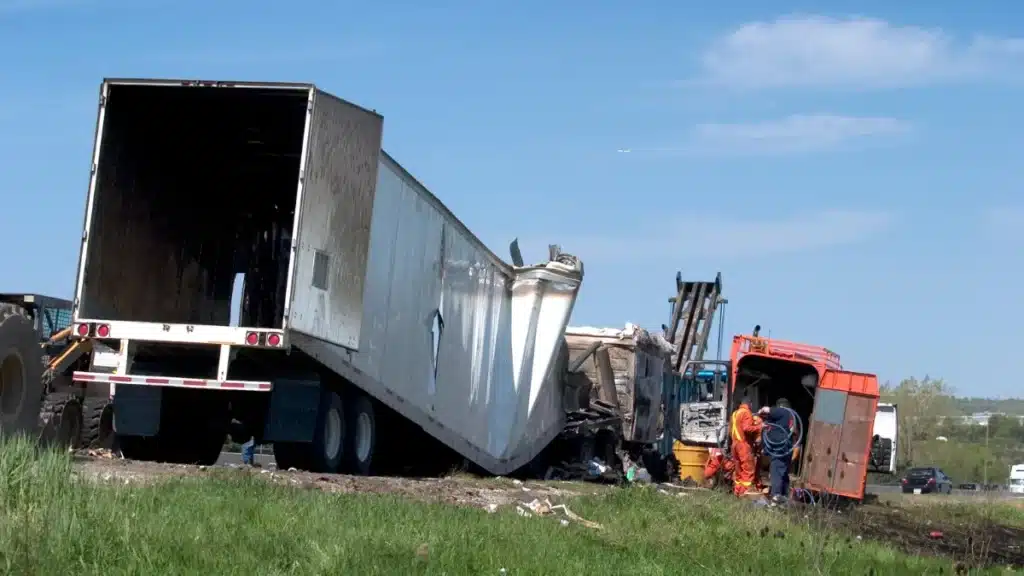
Common Improper Loading Scenarios That Cause Crashes
Uneven Weight Distribution
When weight is concentrated too far forward, backward, or to one side, the trailer can become unstable—especially on curves or during lane changes.
Overloaded Trailers
Exceeding legal or safe weight limits increases stopping distance and stresses braking systems.
Inadequate Load Securement
Missing, worn, or insufficient straps, chains, or blocking allow cargo to shift during normal driving.
Poor Bracing or Blocking
Unbraced cargo can slide forward during braking, causing sudden deceleration and loss of control.
Improper Loading of Liquid or Bulk Cargo
Sloshing liquids or loose bulk materials require specialized loading techniques. Failure to account for load dynamics is negligent.
Who Is Responsible for Proper Loading?
One of the biggest misconceptions is that the truck driver is always responsible for the load. In reality, many parties may be legally responsible.
Potentially Liable Parties Include:
- Shippers
- Loaders and loading dock operators
- Warehouses and distribution centers
- Freight brokers (in certain circumstances)
- Third-party logistics companies
- Trucking companies (if they controlled loading)
- Equipment manufacturers (defective securement devices)
If you did not load the trailer—or were not allowed to inspect or adjust the load—liability may rest elsewhere.
Federal Cargo Securement Regulations Matter
Cargo securement is governed by strict federal regulations enforced by the FMCSA. These rules address:
- Load distribution
- Securement methods
- Number and strength of tie-downs
- Special rules for specific cargo types
- Inspection and re-inspection requirements
Violations of these regulations often serve as strong evidence of negligence.
How Injured Truck Drivers Prove Negligent Loading in Tennessee
Negligent loading cases are won through documentation, expert analysis, and early investigation.
1) Cargo and Shipping Documents
Critical records include:
- Bills of lading
- Load manifests
- Weight tickets
- Securement checklists
- Shipping instructions
These documents help identify who loaded the trailer and how it was supposed to be secured.
2) Scene and Post-Crash Evidence
Photos and videos of:
- Cargo position after the crash
- Shifted or spilled freight
- Broken or missing securement devices
- Damage patterns
This evidence often shows improper loading or securement.
3) Maintenance and Equipment Records
Records may reveal:
- Worn or defective straps or chains
- Broken load bars or anchors
- Failure to replace known defective equipment
Negligent maintenance strengthens liability claims.
4) Expert Cargo Securement Analysis
Experts analyze:
- Load weight and distribution
- Securement adequacy
- Compliance with FMCSA rules
- Whether the load would have shifted under normal driving
Expert opinions are often decisive.
5) Accident Reconstruction
Reconstruction helps establish:
- How the load shift affected vehicle dynamics
- Why the crash was unavoidable
- That the truck driver reacted reasonably
This counters insurance claims of driver error.
Injuries Truck Drivers Commonly Suffer Due to Improper Loading
Improper loading crashes frequently cause:
- Traumatic brain injuries (TBIs)
- Neck and back injuries
- Herniated discs
- Spinal cord injuries
- Shoulder, knee, and hip injuries
- Internal injuries
- Chronic pain
- Permanent disability
These injuries can end or severely limit a trucking career.
Workers’ Compensation vs. Third-Party Negligent Loading Claims
If you were driving for work:
- Workers’ compensation may cover medical care and partial wages
However, workers’ comp does not cover:
- Pain and suffering
- Full lost income
- Loss of future earning capacity
- Long-term disability impact
When negligent loading caused the crash, a third-party injury claim against the responsible parties is often necessary to recover full compensation. These claims can proceed alongside workers’ comp.
Tennessee Comparative Fault and Improper Loading Cases
Insurance companies often argue:
- The driver should have noticed the improper load
- The driver failed to re-secure cargo
- Speed or maneuvering caused the shift
Under Tennessee’s modified comparative fault rule, strong evidence is essential to keep fault where it belongs—on the party who loaded the trailer negligently.
Why Negligent Loading Cases Are Heavily Defended
Corporate defendants often:
- Deny responsibility
- Claim compliance with regulations
- Shift blame to the truck driver
- Dispute expert findings
These cases require aggressive, trial-ready representation.
Common Mistakes Injured Truck Drivers Should Avoid
- Disposing of or altering cargo after the crash
- Failing to photograph the load and trailer
- Giving recorded statements without legal guidance
- Assuming the loader “can’t be sued”
- Settling before expert analysis
Early action preserves critical evidence.
How Tennessee Accident Law Handles Negligent Loading Cases
We know how to take on negligent loaders and corporate defendants:
- Immediate evidence preservation
- Identification of all responsible parties
- Cargo securement and reconstruction expert analysis
- Coordination with workers’ comp claims
- Full damage evaluation
- Trial-ready case preparation
We understand trucking operations and federal cargo regulations.

Take Action Now—Negligent Loading Claims Are Time-Sensitive
If you were injured in a Tennessee truck accident caused by an improperly loaded trailer—and the crash was not your fault—do not let insurers or corporate defendants shift blame.
Complete our free case evaluation form and call us now at 615-212-9866. We’ll review your case, explain your options, and fight for the full compensation you deserve.
Sources
- FMCSA – Cargo Securement Rules and Compliance Guide
Provides federal standards governing load securement and distribution.
https://www.fmcsa.dot.gov/safety/cargo-securement - Federal Motor Carrier Safety Administration – Large Truck Crash Causation Study
Analyzes crash causes, including cargo-related failures.
https://www.fmcsa.dot.gov/safety/data-and-statistics - Tennessee Department of Safety & Homeland Security – Commercial Vehicle Enforcement
Outlines commercial vehicle safety enforcement and inspection practices.
https://www.tn.gov/safety/